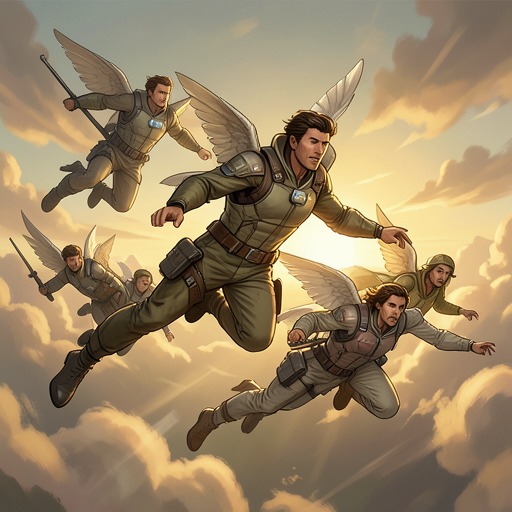
Collective Suicide of the Flyers
Last and First MenThe Collective Suicide of the Flyers is the final act of a defeated flying people: roughly a million survivors chose death in a volcano over a life ruled by the industrial order that had outlawed their way of being. Their disappearance ends the career of Flying Man and leaves the planet to a flightless society built on industry and science.
The Industrial Order and the Defeat of Flight
The Flyers’ last stand followed a deliberate remaking of society. Mechanical flight outstripped natural wings, while industrialists crowded the islands and condemned flight as a barren luxury. The new regime required every Flyer to serve its order or starve; with Windborne plants no longer cultivated and fishing and fowling rights strictly controlled, that threat was practical, not rhetorical. Ground labor initially brought serious ill health and early death, so pedestrian physiologists devised a drug that preserved the workers’ physical condition and even prolonged their lives. It could not restore their spirits: natural flight was reduced to a few tired hours of recreation each week.
The attack on the Flyers’ future extended to reproduction. Breeding experiments sought a wholly wingless, large-brained population, and a law ordered that winged infants be mutilated or destroyed. The Flyers made an armed attempt to reverse their loss of power, attacking the pedestrian population from the air. The counterattack overwhelmed them: the opposing forces rode them down in great aeroplanes and blasted them with high explosive. The defeat made the new order’s control of the ground and the air unmistakable.
The Gathering on the Island
The surviving squadrons were driven to a remote, barren island. Flyers fled there from every civilized archipelago in search of freedom, but the gathered population was only a remnant of its former strength. The sick had already committed suicide, and infants not yet able to fly had been stifled by their mothers or next-of-kin under a decree from the leaders. About a million men, women, and children assembled on the rocks, some scarcely old enough to have endured the long flight. There was no food nearby for so vast a company.
The leaders concluded that the age of Flying Man was over. They judged it more fitting for a high-souled people to die at once than to endure subjection to masters who held them in contempt, and ordered a collective act of suicide as a final gesture of freedom. The people heard the decision while resting on stony moorland. Their first response was a wail of sorrow; the speaker urged them to recognize the beauty of the act even while grounded. They could not yet see it, but believed they would understand once their strength returned in the air.
The Final Flight
Hunger and exhaustion made delay dangerous: many were already faint, and some feared they would no longer be able to rise. At the appointed signal, the whole population lifted off with a deep roar of wings. The account marks a change in their grief as they gained the air: sorrow was left behind. Even the children accepted their fate with zest when their mothers explained it aloft, though they would have been terrified had they learned of it on the ground.
The Flyers headed steadily west, arranging themselves in a double file that stretched for miles. A volcano’s cone rose over the horizon as they approached, and the leaders pressed on toward its ruddy plume of smoke. Couple by couple, the multitude darted into the volcano’s fiery breath and vanished. The event closes not with a negotiated surrender or a surviving community, but with the deliberate destruction of the people who had gathered to escape subjection.
Aftermath and Significance
The flightless, still half-avian race that remained settled down to build a society founded on industry and science. In that transition, the Flyers’ extinction marks more than the defeat of one population: the qualities that had defined their civilization—natural flight and the freedom associated with it—were displaced by mechanical power, industrial labor, and state control. Their final flight briefly recovers the freedom the new order had taken from them, but only as the means of ending their existence.